 Juan Manuel Allo Ron
Six Hats: A Decision Skill That Completes My AI Context Stack
I keep adding small skills to my agent setup, and I keep noticing the same gap: AI is great at collecting and synthesizing, but not at taking sides. When I ask for “thoughts on X,” I usually get a balanced essay where every paragraph hedges the previous one. That’s not a decision — that’s a Wikipedia entry with feelings.
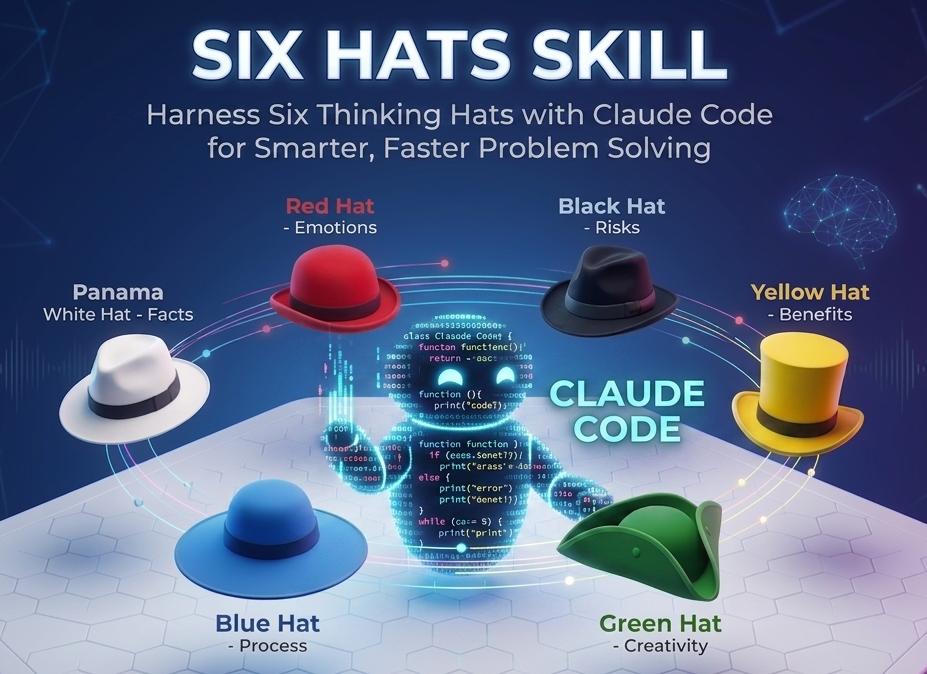
So I built six-hats-skill, a Claude/Cursor skill that runs an Edward de Bono–style six-hats debate over a topic, in three rounds, ending with a moderated recommendation.
The point isn’t the framework. The point is forcing the agent into roles that disagree on purpose, and then making one of those roles synthesize a real call at the end.
What it actually does
You hand it a decision and an output path. It runs three sequential rounds with these roles:
- White Hat — facts, known data, gaps in knowledge
- Red Hat — gut feel, intuition, emotional reaction (no need to justify)
- Yellow Hat — upside, best-case, why this could work
- Black Hat — risks, failure modes, sharpest objections
- Green Hat — alternatives, reframes, lateral options
- Blue Hat — moderator; doesn’t argue, just synthesizes the final call
Each round sees the previous round, so positions can shift, sharpen, or concede. At the end, Blue Hat writes a final recommendation, key agreements, unresolved tensions, and next steps to a markdown file — the format my Obsidian vault wants.
Two examples are in the repo:
The React one is a good demo of the value: the hats actually disagree about whether the framework’s maturity is leverage or a trap, and Blue Hat lands on a real position (“treat your stack as a liability to be managed, not an asset to be defended”) instead of “it depends.” That sentence wouldn’t have come out of a single-prompt synthesis.
Why this slots into a stack of skills
I’ve been leaning on three other skills heavily, and six-hats is the missing fourth corner.
| Skill | What it gives me | When I reach for it |
|---|---|---|
| last30days | Outside-in signal — what Reddit, X, YouTube, HN are actually saying in the last 30 days | Early scoping. “Is this even a real thing right now?“ |
| deep-research | Citation-backed, multi-source synthesis with a real methodology | When I need to trust a claim, not just feel it |
| grill-me | Relentless interview about my plan, branch by branch | After I have a draft plan and need it stress-tested |
| six-hats (new) | Structured internal debate from six opposing lenses, ending in a recommendation | When I need to decide, not just understand |
Each one answers a different question:
- last30days → What’s the world saying?
- deep-research → What’s actually true and well-sourced?
- grill-me → Where is my plan weak?
- six-hats → What’s the right call, given everything above?
If I only use the first three, I end up with a pile of evidence and no decision. Six-hats turns the pile into a position.
The loop I’ve settled into
For anything bigger than a one-day spike, the flow now looks like this:
- last30days
<topic>— quick scan of what’s being discussed right now. This catches things that aren’t in my head yet (new tools, hot takes, dead repos, recent regressions). - deep-research
<topic>— I run this when last30days surfaces a claim I want to lean on. I want citations, not vibes, before I commit to a direction. - six-hats — I feed the topic plus the research into a debate. White Hat now has real facts to cite. Black Hat has real failure modes from production reports. Green Hat has real alternatives instead of made-up ones.
- grill-me — once Blue Hat gives me a recommendation, I let grill-me tear into my version of the plan, branch by branch, until I can’t dodge a question.
- Decide and write it down — usually a short doc in the vault with the Blue Hat synthesis on top, the grill-me transcript below, and links to the research.
The order matters. Six-hats before research is a vibes session. Grill-me before six-hats grills you on a position you haven’t actually picked yet. Putting them in order turns four general-purpose skills into a pipeline.
What changed when I added six-hats
A few things I wasn’t expecting:
- Black Hat catches what I won’t. I’m naturally a Yellow Hat about my own ideas. Having the agent role-play a real devil’s advocate, with the previous round’s optimism in front of it, surfaces objections I would have rationalized away.
- Red Hat is weirdly useful. “What does this feel like?” sounds soft, but it’s where I notice exhaustion, hype-fatigue, or excitement that I should pay attention to. The career example in the repo is mostly carried by Red Hat naming the fatigue.
- Blue Hat forces a position. This is the whole game. The constraint that Blue Hat must end with a final recommendation — not a balanced summary — is what makes the output usable. I disagree with it sometimes, and that’s fine; disagreeing with a clear position is much easier than disagreeing with “here are some considerations.”
- It’s better with research loaded in. Run six-hats cold and the hats invent stats. Run it after last30days + deep-research and the White Hat round reads like a brief. Same skill, very different output.
Things I’d tell myself before building it
- Sequential beats parallel. I tried running the hats in parallel first to save time. The debate quality collapsed — each hat needs to see the previous ones to actually engage. The skill enforces sequential order on purpose.
- Don’t let Blue Hat debate. Early versions had Blue Hat chiming in during rounds. It poisoned the debate — the moderator can’t also be a player. Now Blue Hat only shows up at the end.
- Write the output to disk, every time. Same lesson as my content pipeline post — if it’s not a file in the vault, it didn’t happen. The skill always writes
debate-{timestamp}.mdto the path you specify. - Composability is the point. Six-hats is small on purpose. It doesn’t do research, it doesn’t grill, it doesn’t manage projects. It does one thing — structured opposing debate ending in a recommendation — so it can plug into whatever pipeline I’m in this week.
Try it
If you already have a Claude Code, Cursor, or ~/.agents/skills setup, installation is one line:
git clone https://github.com/juanallo/six-hats-skill ~/.claude/skills/six-hats
(Or ~/.cursor/skills/six-hats, or ~/.agents/skills/six-hats — same shape.)
Then ask your agent something like:
Run a six hats debate on whether we should migrate this app from REST to GraphQL. Save it to
./decisions.
Repo and full SKILL.md: github.com/juanallo/six-hats-skill.
If you’re already using last30days, deep-research, or grill-me, drop six-hats in next to them and try the full loop on a real decision you’re sitting on. The interesting moment is when the four skills disagree with each other. That’s usually where the real call lives.
Catch up with me on X (twitter):@juan_allo
Share
---
Similar Articles
Claude Skills as my personal content pipeline
My Current AI Workflow for Building Apps
Weekly Digest #13: CLI agent fleets, kanban, and parallel runs